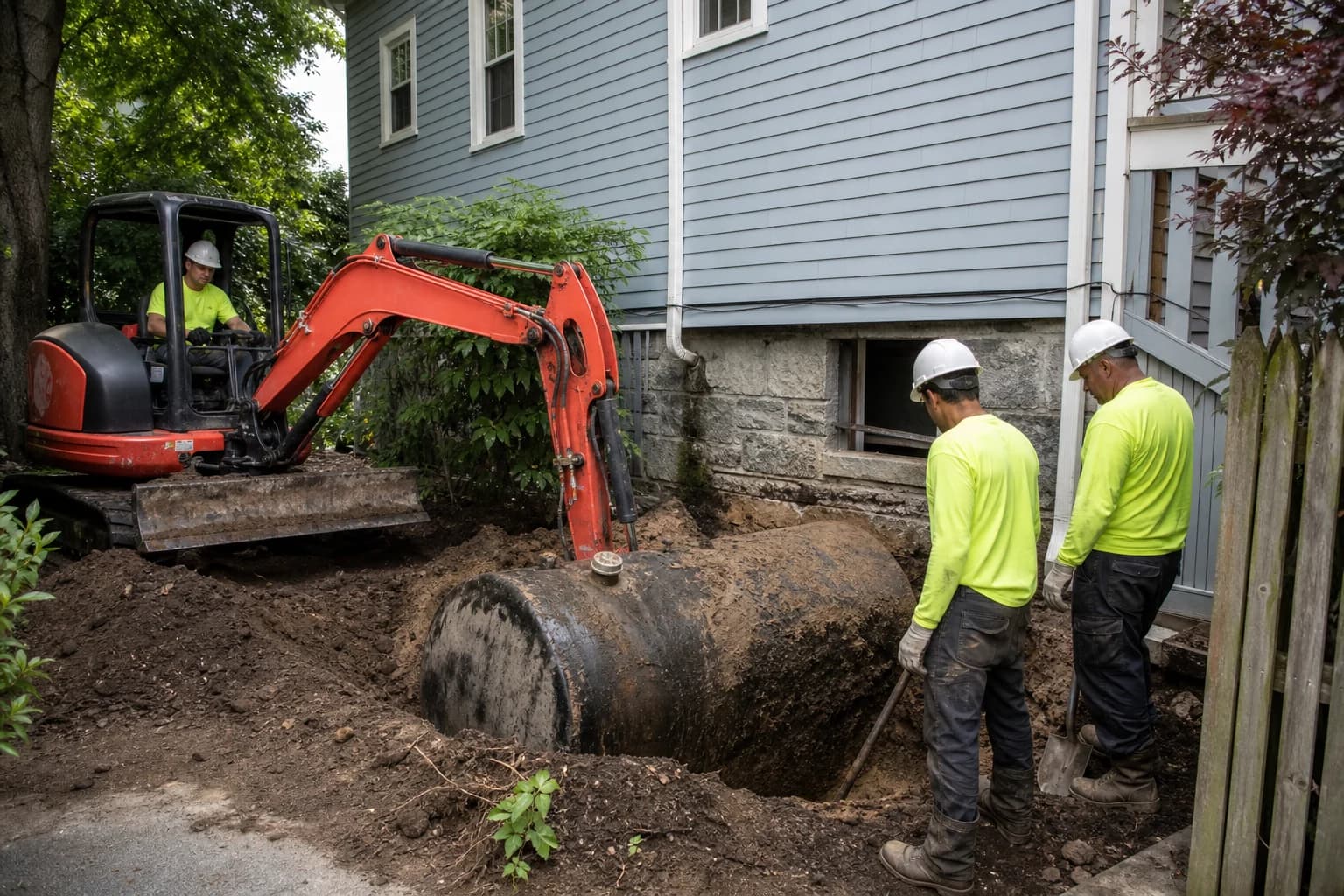
Oil Tank Removal In Providence, RI
Rhode Island half regulates a home heating oil tank. We pull the tank, file the closure that still applies, and tell you which half your property sits in before anything is booked.
- Underground, basement and out-of-use tanks across Providence County
- The DEM closure application prepared and filed, fire department signature included
- A written figure before a date is held, with what would change it
Get A Figure For Your Tank
Where the tank sits and roughly how big it is. That is enough for a written figure and the closure steps for your address.
Which Rules Reach Your Tank
Pick the tank you have. Each answer gives you the part of the regulation that lets go, and the part that does not.
Buried Residential Tank Under 1,100 Gallons
A tank holding heating oil for a one, two or three unit dwelling sits outside most of Rhode Island's underground storage tank regulation once it is 1,100 gallons or less.
Three sections still reach it. Closure, release reporting, and the rules on putting a new tank in. That means a closure application to DEM before anyone digs, not a quiet weekend job.
250-RICR-140-25-1.4(E), applicability and the residential exemption. Cornell Legal Information Institute. Read August 22, 2026.
What The Exemption Takes Away
A tank of 1,100 gallons or less holding heating oil for a one, two or three unit dwelling drops out of most of Rhode Island's underground storage tank regulation. No registration, no operator certification, no leak detection duty, and no routine closure assessment when it comes out clean.
That last one is worth money. Several companies price soil testing into every residential removal as though the state demanded it.
What The Exemption Leaves In Place
Three sections still reach the tank. Closure, which is why an application goes to DEM before anyone digs. Release reporting, which has no residential carve-out at all. And the rules on putting a new tank in the ground, which need approval first.
An exemption is not permission. Rhode Island prohibits abandonment outright, and a tank sitting unused past 180 days is what the regulation calls abandoned.
Oil Tank Removal Cost In Providence County
A straightforward buried tank in Providence County sits in the band the local companies publish, which is $1,500 to $3,500. What moves it is access, depth and what the fill and vent lines run under.
Because Rhode Island exempts a home heating oil tank from the routine closure assessment, sampling is not an automatic line on the quote. It becomes one the moment there is a reason to look.
250-RICR-140-25-1.15, closure. Cornell Legal Information Institute. Read August 22, 2026.
Underground And Basement Tanks In Providence
A buried tank is governed by the closure section, so the application and the fire department signature come before the excavator. A basement tank is not an underground storage tank, so that route does not apply to it at all.
The two jobs share almost nothing beyond the oil. One is a dig and a backfill, the other is a controlled cut and a carry up a set of stairs built in 1910.
250-RICR-140-25-1.4(E), applicability and the residential exemption. Cornell Legal Information Institute. Read August 22, 2026.
The Closure Application And The Fire Department Signature
The permanent closure application goes to DEM at least ten business days before the date, at $75 per tank, plus another $75 for a tank that was never registered. Your local fire department signs that application, and is told the confirmed date once DEM schedules it.
Where a closure assessment is required, the report is due to DEM within thirty days and the certificate follows approval. On a home heating oil tank that assessment is the part the state lets go of.
Instructions for Permanent Closure Application for Underground Storage Tank(s). Rhode Island Department of Environmental Management. Read August 22, 2026. Read from a municipal mirror that still cites the pre-RICR rule numbers, so the form revision is old. The fee, the ten business day notice and the fire department signature all match the current section 1.15 text. Confirm the current form with the DEM UST Section before relying on the fee.
Money Rhode Island Puts Back On A New Tank
If the tank is coming out and an aboveground tank is going back in, Upgrade & Save Rhode Island pays up to $500 toward the new tank and up to $800 toward a boiler or furnace, to a $1,300 ceiling. The program is run by the Energy Marketers Association of Rhode Island and the rebate is processed through a registered Rhode Island Bioheat fuel dealer.
Those amounts changed on April 1, 2026. Most pages still publish the old $1,000 and $400 figures, and funds are limited and allocated first come, first served, so nobody should treat the rebate as banked.
Upgrade & Save Rhode Island rebate amounts. Energy Marketers Association of Rhode Island. Program page states as of April 1, 2026. Funds are limited and allocated first come, first served, and rebates are processed through a registered Rhode Island Bioheat fuel dealer. Most other pages on the web still publish the superseded $1,000 and $400 amounts.
The B20 Change Under An Old Steel Tank
Since July 1, 2025 the No. 2 heating oil sold in Rhode Island has had to meet a B20 standard, and the statute takes it to B50 by July 1, 2030. The earlier steps were B5 in 2021 and B10 in 2023.
That is a change in what the tank is holding, on a schedule set by statute rather than by a supplier. It is a reasonable thing to raise with your fuel dealer if the tank is old, and it is a reason to look at the tank bottom rather than a prediction that it will fail.
RIGL 23-23.7-4, heating oil biobased product content. Rhode Island General Laws, via FindLaw. Source states current through January 1, 2026.
Who Rhode Island Actually Licenses
There is no RIDEM license for removing a home heating oil tank. RIDEM certifies UST operators in Class A, Class B and Class C for regulated facilities, and the Contractors' Registration and Licensing Board licenses Underground Utility, Water Filtration, Well Drilling and Pump Installers.
Anyone advertising as a RIDEM-licensed tank contractor is describing something that does not exist. Ask instead for registration with the CRLB, evidence of insurance, and the closure application with the contractor named on it.
Rhode Island Contractors' Registration and Licensing Board. State of Rhode Island. Read August 22, 2026.
The Paperwork That Outlives The Job
What survives the excavator is the file. The approved closure application, the disposal record for the tank and the oil, and where an assessment was done, the DEM certificate that closes it out.
Rhode Island's seller disclosure form names underground tanks inside the heating system item, so this file is the thing a buyer's attorney asks for years later.
RIGL 5-20.8-2, real estate seller disclosure requirements. Rhode Island General Laws, via FindLaw. Read August 22, 2026.
Where We Work In Providence County
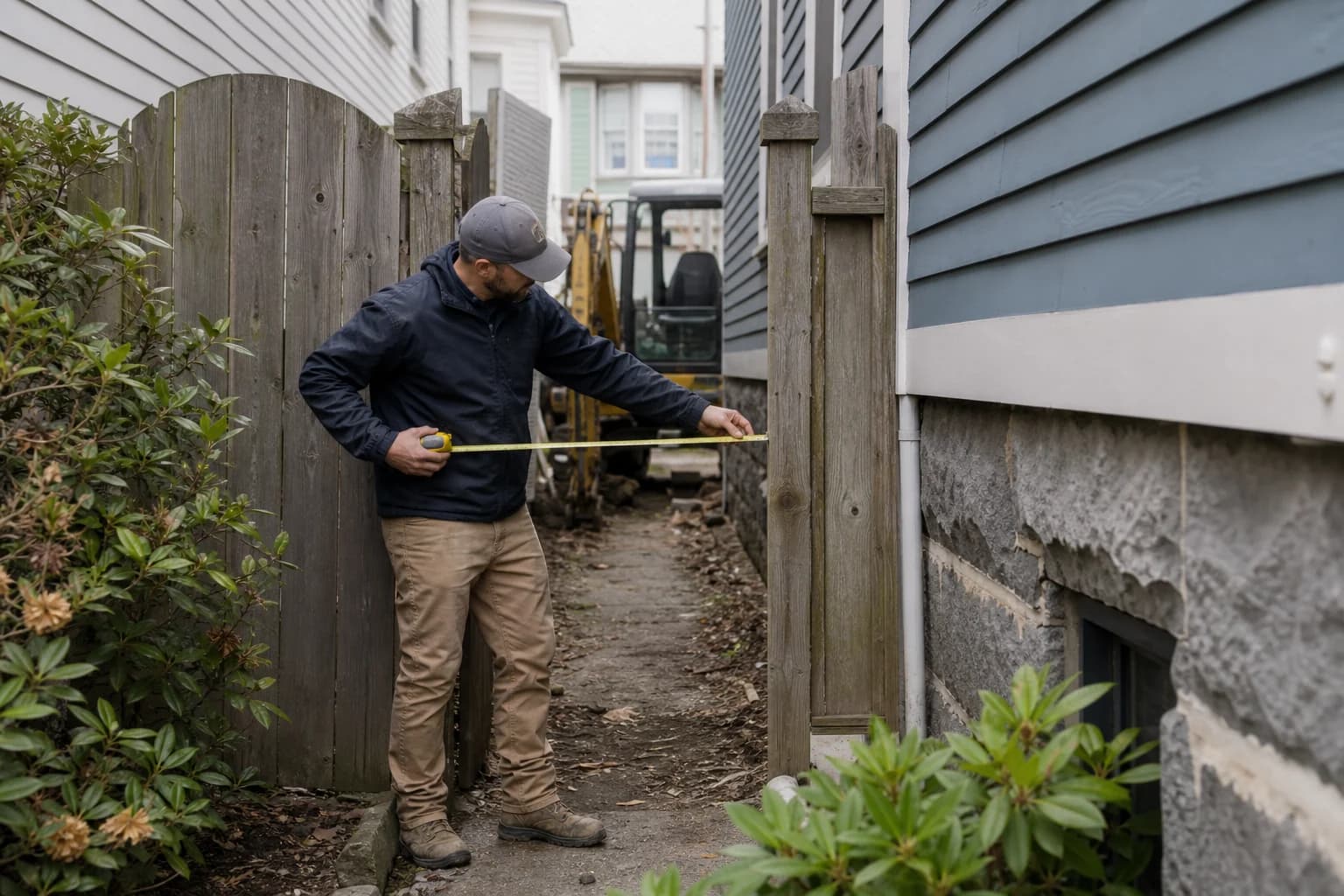
Sixteen municipalities, and the thing that changes the job is almost always access rather than distance. What sits between the machine and the tank decides the method.
Providence
Dense triple-deckers and narrow side yards on the East Side and Federal Hill
Cranston
Postwar subdivisions where the fill pipe is usually still visible
Pawtucket
Mill housing with basement tanks reached through a bulkhead
East Providence
Riverside and Rumford lots with tanks set close to the foundation
Woonsocket
Older two and three family houses, often on shared driveways
North Providence
Compact lots where excavator access decides the method
Johnston
Larger yards, and tanks that were set well away from the house
Central Falls
The state's densest square mile, so street access is the constraint
Cumberland
Mixed stock, from mill village rows to newer builds on rock
Lincoln
Long driveways where the machine has to reach past the house
Smithfield
Properties off the public main, where a release question widens
Scituate
Reservoir country, so the water supplier enters the reporting list
Glocester
Rural lots on private wells and long unpaved driveways
Burrillville
Older heating systems and tanks that predate any registration
Foster
Wooded lots where the tank was set wherever the truck could reach
North Smithfield
Farm and residential tanks that sit under the same threshold
Prices Rhode Island Companies Publish
These are other companies' published figures, read on the dates shown. They are here because the spread is the useful information, and because two of these pages contradict themselves.
| Job | Published range | Who published it |
|---|---|---|
| Aboveground tank removal, within 30 miles of Providence | $600 flat | Jacobs Property Solutions, removemyoiltank.com, promotional rate |
| Aboveground tank removal | $350 to $700 | tankremovers.com |
| Underground residential tank removal | $1,500 to $3,500 | ustcontractors.com and oiltankremovalprovidenceri.com |
| Underground residential tank removal | $900 to $3,500 | tankremovers.com blog, against $1,500 to $3,000 on its own service page |
| Basement tank with confined access | $2,500 to $5,000 | ustcontractors.com |
| Remediation where oil has reached the soil | $10,000 to $90,000 and up | oiltankremovalprovidenceri.com |
| 275 gallon tank replacement, New England average | $4,150 | commtank.com |
Read August 22, 2026. Ranges move, and a published range is not a quote for your property. What actually moves the number in Rhode Island
Oil Tank Removal Near Me In Providence
Searching from a Providence address returns companies working the whole of southern New England, most of them based outside the county. We work Providence County, which is why the coverage list above is sixteen towns rather than six states.
The Providence Fire Department publishes seven permit types and none of them is a tank permit. Its part in a closure is the signature on the DEM application and notice of the confirmed date.
Providence Fire Department permit list. City of Providence. Read August 22, 2026.
Questions Providence Owners Ask
Do I need a permit to remove an oil tank in Rhode Island?
For an underground tank, the document is a permanent closure application to the Department of Environmental Management rather than a city permit. It goes in at least ten business days ahead, costs $75 per tank plus another $75 for a tank that was never registered, and it has to be signed by an authorized agent of your local fire department. Providence itself publishes seven fire department permit types and none of them is a tank permit.
Does Rhode Island make me test the soil when the tank comes out?
Not as a matter of routine. Section 1.15(A) of the underground storage tank regulation exempts tanks storing fuel oil consumed on site solely for heating from the closure assessment, and the DEM instruction sheet says the same thing in plain words. Sampling becomes necessary when there is evidence of a release, and at that point reporting duties apply with no residential exemption at all.
Can I just leave the tank in the ground?
No. Rhode Island prohibits abandonment outright, and a tank out of service for more than 180 days without approved temporary closure is treated as abandoned. Closure in place is a separate and permitted method, used where taking the tank out would undermine a structure or utilities, and it needs approval, product removal, capping and a slurry fill. Doing nothing is not one of the choices.
Can I sell a house in Rhode Island with an underground oil tank?
Yes. The mandatory seller disclosure form names underground tanks within the heating system item and goes to the buyer no later than before signing any agreement to transfer. Failing to provide the form does not void the agreement and does not create a defect in title, and it carries a civil penalty of $100 per occurrence. That is the statute, not the market: a buyer, lender or attorney can still refuse to proceed.
How much does oil tank removal cost in Providence?
The Rhode Island companies publishing figures cluster at $1,500 to $3,500 for a straightforward buried residential tank, and around $600 for an aboveground tank near Providence. Basement tanks with awkward access are published higher, at $2,500 to $5,000. Those are their numbers, read in August 2026, and they are a band rather than a quote for your property.
Is there a Rhode Island grant for replacing an oil tank?
There is a rebate rather than a grant. Upgrade & Save Rhode Island, run by the Energy Marketers Association of Rhode Island, pays up to $500 toward a new aboveground oil storage tank and up to $800 toward an oil-fired boiler or furnace, to a $1,300 ceiling, as of April 1, 2026. It has to be processed through a registered Rhode Island Bioheat fuel dealer, and funds are limited and allocated first come, first served.
Does Rhode Island license oil tank removal contractors?
Not for this work. RIDEM runs a UST Operator Certification scheme in Class A, Class B and Class C for people operating regulated facilities, and the Contractors' Registration and Licensing Board licenses Underground Utility, Water Filtration, Well Drilling and Pump Installers. A company advertising a RIDEM tank removal license is describing a credential the state does not issue.
What happens if there is oil in the soil?
The reporting duty is immediate and it has no residential carve-out. A confirmed or suspected release goes to the Director, to the local fire official, and to the local public water supplier where the property sits in a watershed or wellhead protection area. From that point the job is a remediation rather than a removal, and the published local range for that work runs from five figures upward.
A Written Figure Before Anything Is Booked
Tell us where the tank sits and roughly how big it is. You get a written figure, the closure steps that apply at your address, and a plain answer on whether soil sampling is in scope or not.