Underground Oil Tank Removal In Providence, RI
A buried heating oil tank at a one, two or three unit house is the case Rhode Island half regulates. Most of the underground storage tank regulation lets go of it at 1,100 gallons, and the closure section does not.
That is the whole shape of the job here. An application before the dig, a fire department signature on it, and a defensible file afterward.
Last reviewed August 22, 2026.
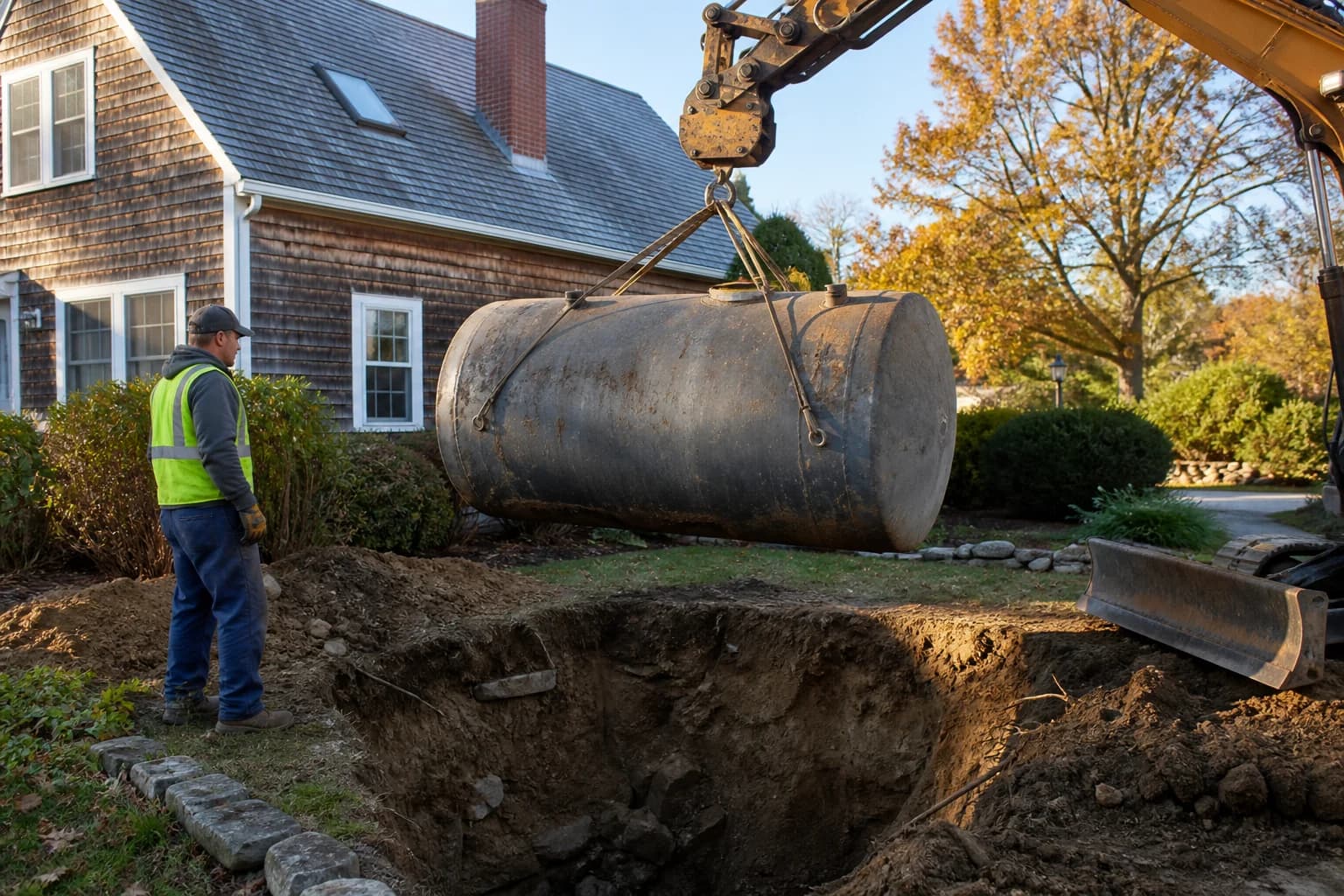
Underground Oil Tank Removal Permits In Providence
The permanent closure application goes to the Department of Environmental Management at least ten business days before the proposed date, and DEM recommends four weeks if you want a date of your choosing. It costs $75 per tank, plus a further $75 for any tank that was never registered with the UST program.
The tank owner signs it, not the contractor, and an authorized agent of your local fire department signs it as well. DEM then schedules the date by telephone and the owner confirms on the day.
Instructions for Permanent Closure Application for Underground Storage Tank(s). Rhode Island Department of Environmental Management. Read August 22, 2026. Read from a municipal mirror that still cites the pre-RICR rule numbers, so the form revision is old. The fee, the ten business day notice and the fire department signature all match the current section 1.15 text. Confirm the current form with the DEM UST Section before relying on the fee.
When Soil Sampling Is Actually In Scope
Rhode Island exempts tanks storing fuel oil consumed on site solely for heating from the closure assessment, which is the routine sampling step. So on an ordinary residential removal it is not a state requirement and it does not belong on the quote as one.
It comes into scope the moment there is a reason to look: stained soil, an odor in the excavation, a tank with a hole in it, or a buyer who wants sampling regardless. We say which of those we are looking at before the machine moves.
250-RICR-140-25-1.15, closure. Cornell Legal Information Institute. Read August 22, 2026.
What Happens If The Excavation Smells Of Oil
Reporting is immediate and it has no residential exemption. It goes to the Director, to the local fire official, and to the local public water supplier where the property sits in a watershed or wellhead protection area.
At that point the job stops being a removal and becomes a remediation, with a different scope, a different price and a different file at the end. The published local figures for that work start in five figures.
250-RICR-140-25-1.14, release reporting. Cornell Legal Information Institute. Read August 22, 2026.
Closure In Place, And What It Is Not
Where taking the tank out would undermine a building, utilities or a sensitive area, Rhode Island permits closure in place with the Director's approval. Product comes out, lines are disconnected and capped, and the tank is filled with a concrete slurry.
That is a method. Abandonment is not, and the regulation says so directly: a tank out of service more than 180 days without approved temporary closure is treated as abandoned.
250-RICR-140-25-1.15, closure. Cornell Legal Information Institute. Read August 22, 2026.
Access In A Providence County Yard
What decides the method is almost never the tank. It is the gate width, the driveway surface, the utilities between the street and the fill pipe, and whether a machine can stand where the spoil has to go.
On an East Side lot the answer is often a smaller machine and a longer day. In Johnston or Foster it is usually a straightforward pull.
Putting A New Tank Back Underground
If a replacement is going back in the ground rather than into the basement, the new and replacement section still applies to a residential tank. No construction of a new or replacement tank system starts without prior written notification to and approval by the Director.
Most Rhode Island replacements go aboveground instead, which is a different route and the one the state rebate is written around.
250-RICR-140-25-1.11(B), new and replacement tank systems. Cornell Legal Information Institute. Read August 22, 2026.
Underground Removal Questions In Providence
How long does an underground tank removal take on site?
The site work on a straightforward residential tank is normally a single day. The schedule is set by the ten business day notice to DEM and the date DEM gives you, not by the digging, which is why the application goes in first and four weeks ahead is the safer plan.
Who signs the closure application?
The tank owner signs it, and an authorized agent of your local fire department signs it as well. Your fire department also has to be told the confirmed date once DEM schedules it.
Is a certificate issued at the end?
Where a closure assessment was required, DEM issues a certificate of closure after it reviews and approves the assessment report, which is due within thirty days of the closure. On a residential heating oil tank the assessment is the exempt step, so what you hold is the approved application and the disposal records rather than a certificate.
The Closure Application For Your Tank
Send the address and what you can see of the tank. You get the application steps that apply, a written figure, and a plain answer on whether sampling is in scope.