Oil Tank Removal In Rhode Island
Rhode Island does not treat a home heating oil tank the way it treats a gas station. It takes the tank out of most of the underground storage tank regulation at 1,100 gallons, then names three sections that still apply to it.
Knowing which of the two halves you are in is the difference between a $75 application and a job somebody has to redo.
Last reviewed August 22, 2026.
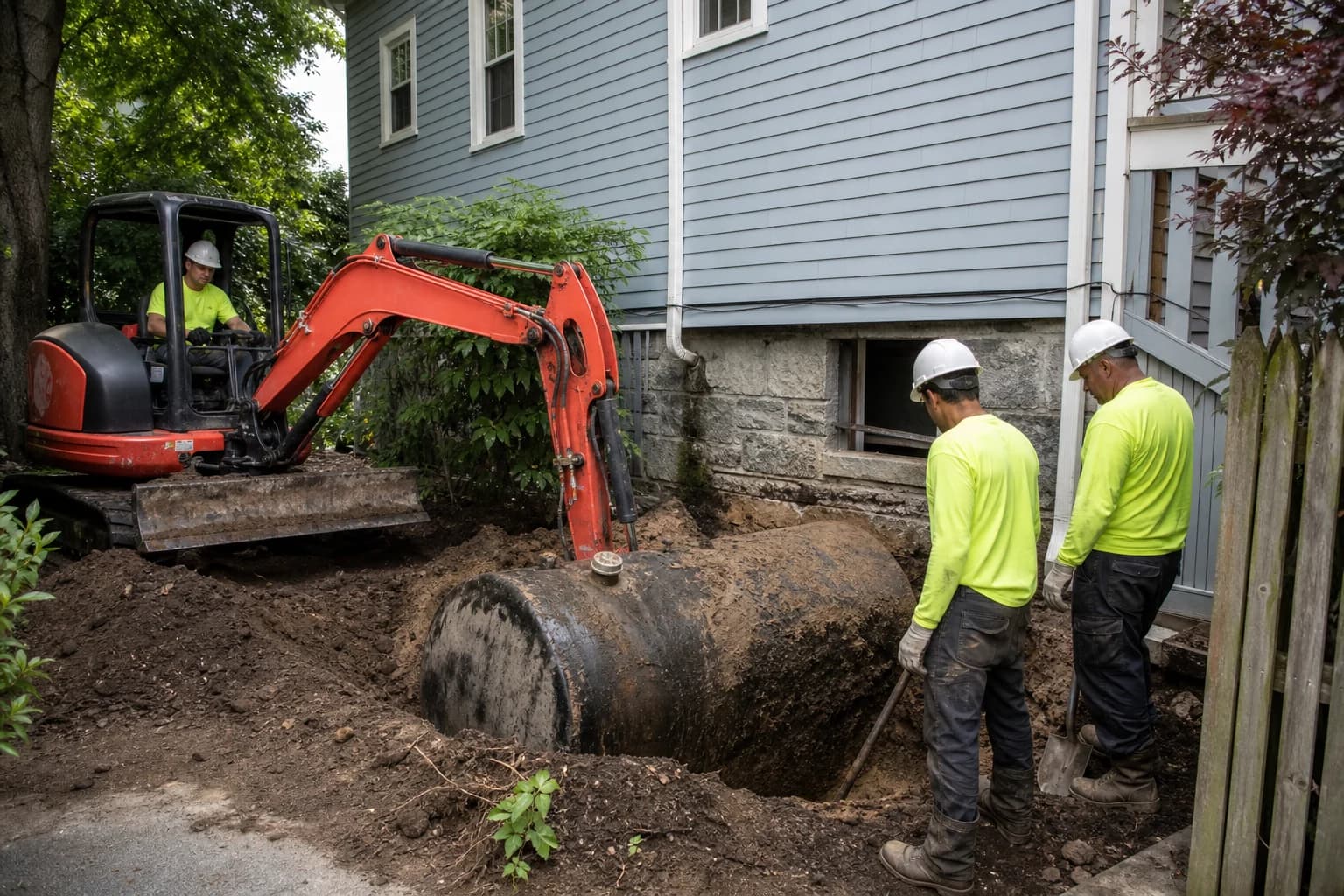
Rhode Island Oil Tank Removal And The 1,100 Gallon Line
A residential tank is defined as one containing heating oil of any grade serving a one, two or three residential unit. At 1,100 gallons or less it falls outside the regulation, except for the sections on closure, on release reporting, and on new and replacement tank systems.
Domestic tanks in Rhode Island are almost always 275 or 550 gallons, so in practice nearly every house sits on the exempt side of that line, and nearly every house still owes the three sections.
250-RICR-140-25-1.4(E), applicability and the residential exemption. Cornell Legal Information Institute. Read August 22, 2026.
Removing An Oil Tank In Rhode Island, Step By Step
Application to DEM, ten business days minimum, $75 per tank. Local fire department signs it, DEM schedules the date, the owner confirms it. Oil out, tank out, hole backfilled, disposal documented.
A closure assessment report, where one is required, goes to DEM within thirty days and the certificate follows approval. On a home heating oil tank that assessment is the exempt step.
Instructions for Permanent Closure Application for Underground Storage Tank(s). Rhode Island Department of Environmental Management. Read August 22, 2026. Read from a municipal mirror that still cites the pre-RICR rule numbers, so the form revision is old. The fee, the ten business day notice and the fire department signature all match the current section 1.15 text. Confirm the current form with the DEM UST Section before relying on the fee.
What Rhode Island Does Not Require
No registration for a residential tank. No certified operator. No leak detection duty. No routine soil sampling on closure. No removal deadline hanging over a tank that is still in service.
Four of those five appear as requirements on pages currently ranking for this term, which is the reason this page exists.
250-RICR-140-25-1.4(E), applicability and the residential exemption. Cornell Legal Information Institute. Read August 22, 2026.
The One Duty With No Exemption
Release reporting reaches everyone. A confirmed or suspected leak is reported immediately to the Director, to the local fire official, and to the local public water supplier where the property is in a watershed or wellhead protection area.
The regulation names the DEM UST Section at (401) 222-2797 for working hours contact.
250-RICR-140-25-1.14, release reporting. Cornell Legal Information Institute. Read August 22, 2026.
Rhode Island Towns Where This Comes Up Most
Providence County carries the oldest concentration of oil-heated housing in the state, and Woonsocket, Pawtucket, Central Falls and the Providence neighborhoods north of the river carry most of it.
We work Providence County. Outside it, the state rules on this page are the same and the fire department signing your application is a different one.
The Heating Oil Itself Changed In 2025
Since July 1, 2025 all No. 2 distillate heating oil sold in Rhode Island has had to meet a B20 standard, on a statutory schedule that reaches B50 by July 1, 2030.
That is a live fact about what is sitting in every tank in the state and it is worth raising with a fuel dealer before deciding whether an old tank stays.
RIGL 23-23.7-4, heating oil biobased product content. Rhode Island General Laws, via FindLaw. Source states current through January 1, 2026.
Rhode Island Removal Process Questions
Is a homeowner allowed to remove their own oil tank in Rhode Island?
The closure application is signed by the tank owner, and the regulation does not create a contractor licensing gate for this work. That is not the same as it being a sensible job to do yourself: the reporting duty on a suspected release attaches to whoever finds it, and the disposal of the tank and the residue is regulated waste handling.
How long does the whole process take in Rhode Island?
Ten business days is the minimum notice to DEM and four weeks is what DEM recommends if you want a particular date. The site work on a residential tank is usually one day, and where a closure assessment applies the report is due within thirty days.
Does Rhode Island have a deadline to remove an old tank?
Not for a residential heating oil tank. The single-walled closure deadlines in the regulation sit in the sections the residential exemption removes. What does bite is the 180 day rule: a tank out of service that long without approved temporary closure is treated as abandoned, and abandonment is prohibited.
A Rhode Island Removal Figure
We work Providence County. Send the address and the tank details and you get the state steps that apply to it, with the figure.