Basement Oil Tank Removal In Rhode Island
A tank standing on a basement floor is not an underground storage tank, so the closure application route does not govern it. That removes the ten day notice, the $75 fee and the fire department signature from the job entirely.
What it does not remove is the oil, the sludge in the bottom, and the problem of getting a steel cylinder up a set of stairs built for people.
Last reviewed August 22, 2026.
Basement Oil Tank Removal Rules In Rhode Island
Rhode Island's underground storage tank regulation is written around tanks in the ground, and the closure section that catches a buried residential tank is part of that regulation. A basement tank sits outside it.
That is a smaller job and a shorter timeline, and it is the reason the aboveground figures published locally are a fraction of the buried ones.
250-RICR-140-25-1.4(E), applicability and the residential exemption. Cornell Legal Information Institute. Read August 22, 2026.
Getting The Tank Out Of A Rhode Island Basement
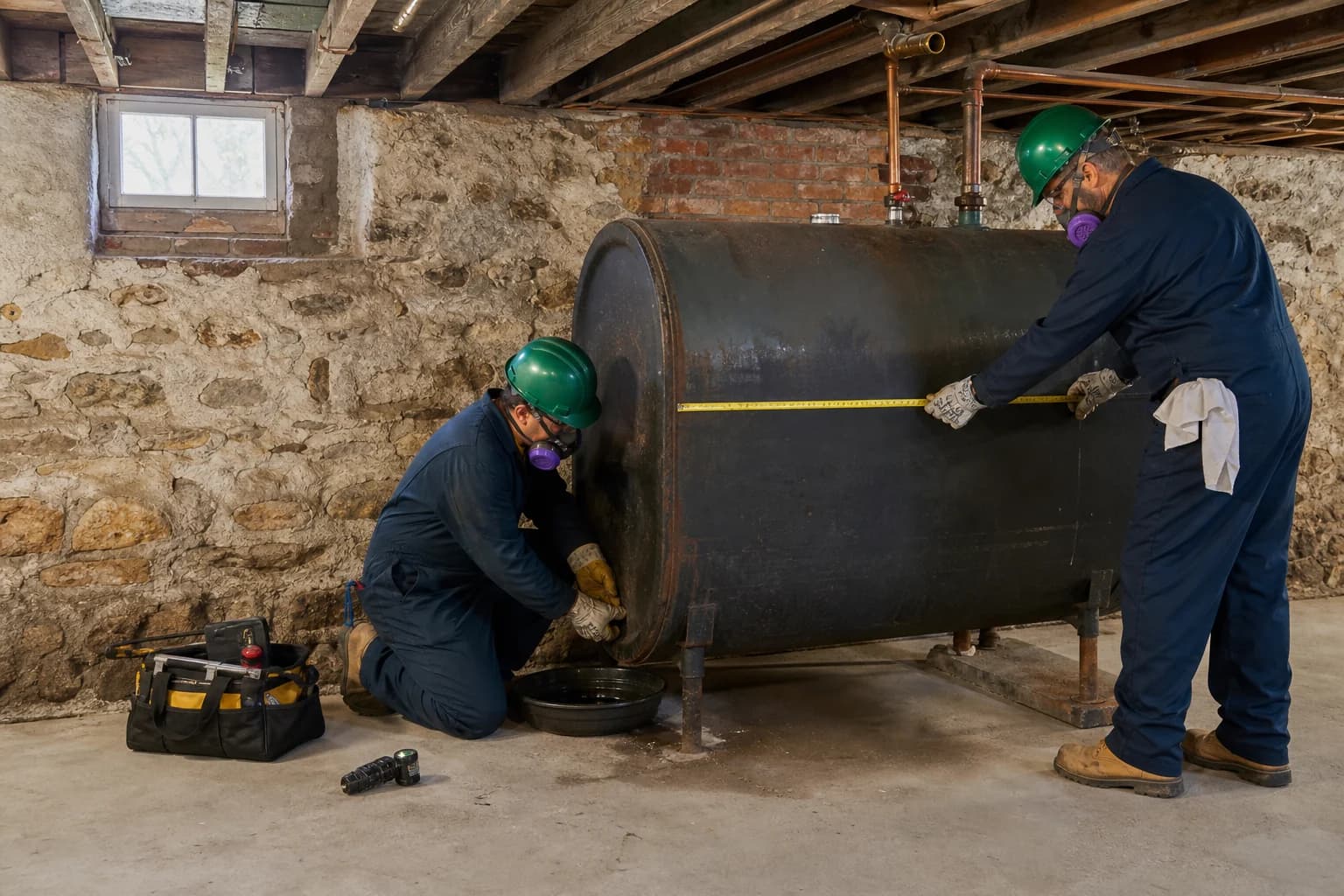
Remaining oil is pumped and the tank is cleaned before anything is cut, because a tank with residue in it is the part of this work that goes wrong. Where the bulkhead or the stair turn will not take a 275 gallon cylinder, the tank is cut down inside and carried out in sections.
Pawtucket and Woonsocket mill housing is where this comes up most, because the bulkhead was built before the tank was.
The Sludge Nobody Mentions On The Phone
The bottom of a forty year old tank is water, sediment and heavy residue rather than usable oil, and it is handled and disposed of as waste. It is also the reason an accurate figure needs to know roughly how much is left in the tank.
A quote given without that question is a quote that will move.
The Replacement Tank And The $500 Back
If a new aboveground tank is going in, Upgrade & Save Rhode Island pays up to $500 toward it and up to $800 toward an oil-fired boiler or furnace, to a $1,300 ceiling, as of April 1, 2026. It is run by the Energy Marketers Association of Rhode Island and processed through a registered Rhode Island Bioheat fuel dealer.
Funds are limited and allocated first come, first served, so it is worth confirming availability with the dealer before the work is scheduled rather than after.
Upgrade & Save Rhode Island rebate amounts. Energy Marketers Association of Rhode Island. Program page states as of April 1, 2026. Funds are limited and allocated first come, first served, and rebates are processed through a registered Rhode Island Bioheat fuel dealer. Most other pages on the web still publish the superseded $1,000 and $400 amounts.
Oil On A Basement Floor
A weep at a seam or a wet ring under the tank is a suspected release, and the reporting duty attaches to it in the same terms as it does outside. Immediate, and to three recipients rather than one.
Concrete is not a seal. Where oil has been sitting long enough to stain, what is underneath the slab is the question worth answering before the tank is replaced.
250-RICR-140-25-1.14, release reporting. Cornell Legal Information Institute. Read August 22, 2026.
Basement Tank Questions From Rhode Island Owners
Do I need a permit to remove a basement oil tank in Rhode Island?
The DEM permanent closure application covers underground storage tanks, so it does not apply to a tank standing on a basement floor. The Providence Fire Department publishes seven permit types and none of them is a tank permit either. That said, the fire code position on aboveground tanks was not part of our research and we are not going to state it as settled.
Can a 275 gallon tank get out through a bulkhead?
Often yes, and often not. Where the bulkhead, the stair turn or a later partition wall will not take it whole, the tank is emptied, cleaned and cut down inside, then carried out in sections. That decision is made at the property rather than on the phone.
What does a basement tank removal cost in Rhode Island?
The Rhode Island companies publishing figures put aboveground tank removal at around $600 near Providence and in a $350 to $700 band generally, with confined basement access published higher at $2,500 to $5,000. Those are their numbers, read in August 2026.
A Figure For The Basement Tank
Tell us the tank size, roughly how much oil is left, and how it would come out of the building. That is enough for a figure that holds.